Information for providers
The Discover Uni website is owned and operated by the UK higher education funding and regulatory bodies:
- The Department for the Economy in Northern Ireland
- The Office for Students in England
- The Scottish Funding Council
- Medr (the Commission for Tertiary Education and Research in Wales) - (formerly HEFCW, The Higher Education Funding Council for Wales).
It includes official statistics about higher education courses taken from national surveys and data collected from universities and colleges about all their students.
Read our sections below for information for providers, including:
- how to submit or amend the course information displayed on Discover Uni
- guidance on the configuration and display of the Discover Uni widget on your own course pages.
Information on course pages


The data on Discover Uni is called the Discover Uni dataset (formerly known as the Unistats dataset). We operate the data collection in partnership with the Higher Education Statistics Agency (HESA), who are now a part of Jisc.
Discover Uni currently displays data from the 2025 Discover Uni dataset. This dataset contains information relevant to courses that will run in the 2026-27 academic year.
OfS-registered higher education providers in England, and providers in Scotland, Wales and Northern Ireland are required to submit an annual Discover Uni data submission to HESA which includes details of their eligible undergraduate courses. To find out if a course is eligible to be returned in a providers’ Discover Uni data submission, please see the coverage statement on the HESA website.
The Discover Uni dataset is comprised of the information that providers submit to HESA in their Discover Uni data submission, as well as data from the National Student Survey, Graduate Outcomes Survey and LEO, and information about quality assessment and standards.
Providers can update their existing information on Discover Uni by resubmitting their Discover Uni data to HESA. The Discover Uni dataset is updated weekly, and any changes will be reflected in the dataset and on the Discover Uni website at that point.
Detailed guidance on the content of the data collection is available on the HESA website. For specific queries, please contact the HESA Liaison team: [email protected].
Please note that newly registered providers in England are required to submit and sign off a Discover Uni data return within two months of the date of registration with the Office for Students.
Further details on the data items we publish on course pages can be found on our 'about our data' page.
Provider contact details
The Discover Uni dataset contains provider names and contact details from the UK Register of Learning Providers (UKRLP). Discover Uni will present this information as it is set out in the provider's own UKRLP record under the 'provider trading name'. If no trading name exists on UKRLP, the legal name is used instead.
Providers can update their UKRLP record at any time, and any changes made will be reflected on Discover Uni after the Discover Uni dataset weekly update.
Discover Uni widget
What is the widget?
The widget supports prospective students to access official data about courses, to help them with their research and decision making.
The Discover Uni widget is embedded onto course pages on provider websites. The widget provides a headline of the Discover Uni data associated with that course, as well as a direct link to the corresponding course page on the Discover Uni website. Providers are expected to display a widget on their course pages for each course that is present on Discover Uni.
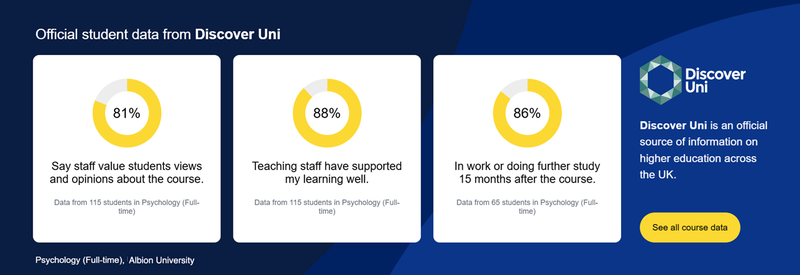
The data displayed on the widget is:
- % in work or doing further study 15 months after the course from the Graduate Outcomes Survey.
- % of students in the National Student Survey say staff have supported their learning well.
- % of students in the National Student Survey were satisfied overall with their course (for providers in Northern Ireland, Scotland and Wales only).
- % of students in the National Student Survey who said staff value students’ views and opinions about the course(for providers in England only).
New Discover Uni widget - 2025
A re-design of the Discover Uni widget was announced within the previous widget guidance (24061).
The new widget is now available. Please refer to the 2025 Discover Uni widget guidance which outlines the process for adding the updated widget to provider course pages.
We encourage you to try the new widget and provide feedback on the new design, configurator tool and the guidance materials.
What’s changed?
The updated widget offers an improved user experience through a clearer design, functionality to scroll through the key information, and accessibility enhancements. The new widget has been designed and iterated throughout a period of user testing with prospective students and a sample of universities and colleges.
An example of the new widget design can be seen below:
What do you need to do?
The new Discover Uni widget should appear on all university or college websites where a course is running and accepting applications for the following academic year, by Friday 5 December 2025.
Providers will need to remove the current widget and switch to the new design. The current widget will be removed and unavailable from summer 2026.
How to set up the new widget
See the 2025 widget guidance for support on how to set up the new Discover Uni widget.
The new widget configurator tool will help providers to generate the code snippet for the widgets to be included on course pages.
All information provided on the widget is taken from the Discover Uni dataset. The details included to configure the widget must match the corresponding course information submitted in your data which has been collected for inclusion in the Discover Uni dataset.
Please note that the widget may not display all the data items listed above if the data is not available on the corresponding course page on Discover Uni – please see the guidance for full details.
Need support?
If you have any questions, feedback or need further support, please contact us at [email protected].
Back
to top
to top